Monetary Shocks and Labor Income Risk with a Billion Observations
Dec 1, 2025·, ·
0 min read
·
0 min read
Mario Giarda
Ignacio Rojas
Sergio Salgado
Abstract
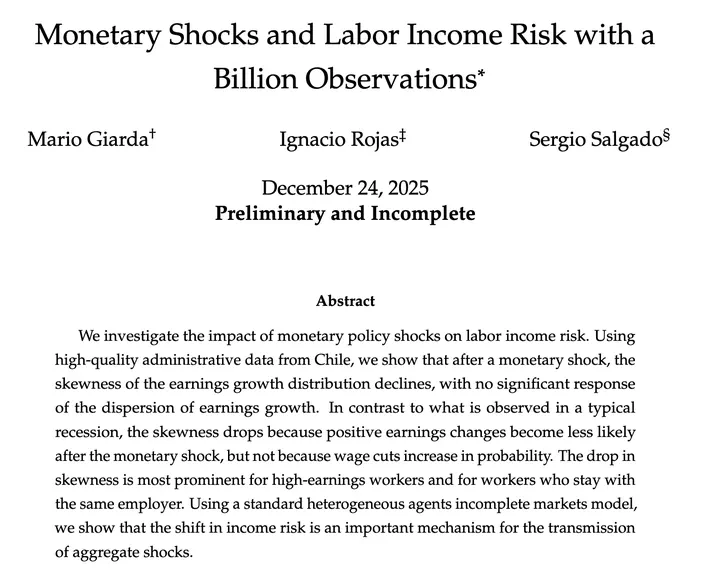
We investigate the impact of monetary policy shocks on labor income risk. Using high-quality administrative data from Chile, we show that after a monetary shock, the skewness of the earnings growth distribution declines, with no significant response of the dispersion of earnings growth. In contrast to what is observed in a typical recession, the skewness drops because positive earnings changes become less likely after the monetary shock, but not because wage cuts increase in probability. The drop in skewness is most prominent for high-earnings workers and for workers who stay with the same employer. Using a standard heterogeneous agents incomplete markets model, we show that the shift in income risk is an important mechanism for the transmission of aggregate shocks.