Skewed Business Cycles
Jul 17, 2026·, ·
0 min read
·
0 min read
Nicholas Bloom
Fatih Guvenen
Sergio Salgado
Abstract
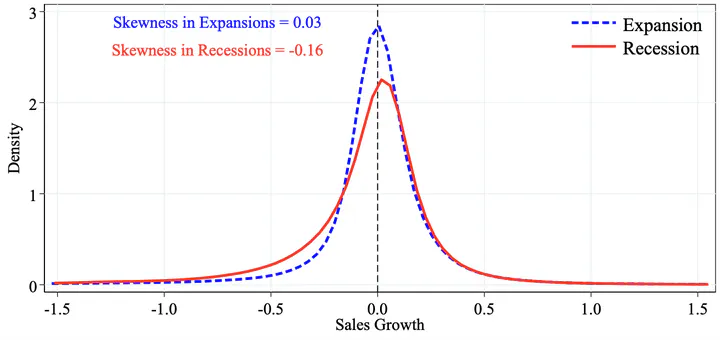
Using Census and Compustat firm panel data, we show that the skewness of four measures — the growth rate of sales, employment, productivity, and firm value — is robustly procyclical. All four display a fat left tail of large negative outcomes during recessions and a compressed right tail. This holds across US industries and over 60 countries. Using a firm dynamics model with adjustment costs, risk aversion, and financial frictions solved in general equilibrium, we analyze the impact of first-, second-, and third-moment shocks. A second-moment shock generates a sharp downturn followed by a rapid recovery, whereas concentrating the same total variance in the left tail—a negative third-moment shock—produces a persistent recession matching the depth and slow recovery observed in US data. Modeling recessions as a combination of negative first-moment, positive second-moment, and negative third-moment shocks is critical to match both the cross-sectional moments of firm growth and the aggregate response to recessions.
Type
Publication
Working Paper