Markup Accounting
Jul 19, 2026·, ·
0 min read
·
0 min read
Juan Holguín
Sergio Ocampo
Sergio Salgado
Abstract
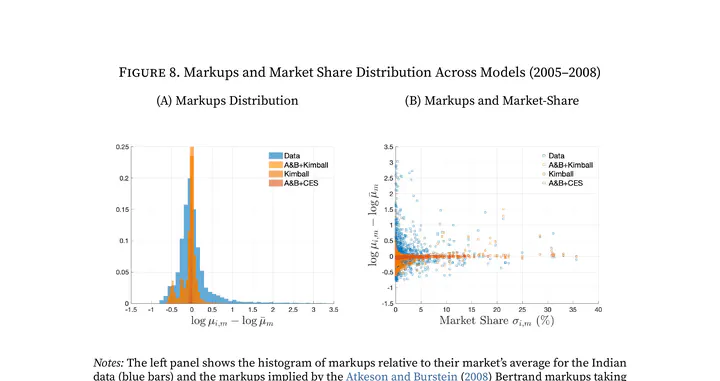
We document new facts of markup dispersion across the firm size distribution using a large sample of firms in India, the US, and 10 European countries. The main result is that markup differences between firms of similar size account for over half of the overall dispersion, calling for mechanisms that affect markups beyond market concentration. To study these mechanisms, we develop an analytical oligopolistic competition model of variable markups that accounts for the observed joint distribution of markups and firm size, including the large mass of small firms with high markups and the presence of large firms with small markups. The key ingredient is the introduction of firm-specific demand elasticity shifters that account for differences in markups between firms of similar size. We apply this model to Indian and U.S. firm data and find consistent results throughout. Without demand elasticity shifters, equilibrium markups collapse to those of standard static models of oligopolistic or monopolistic competition, which capture less than half of the observed variation in markups and counterfactually assign most of the variation to differences between firms of different size. In aggregate, the model implies efficiency losses from markup dispersion that are four to ten times larger than those implied by standard models of heterogeneous markups.
Type
Publication
Working Paper